The Fokker D.VII in Germany
The D.VII started to arrive at the front in great numbers in april 1918. The German pilots were very pleased with them, and were dissapointed when they had to fly other aircraft like the Albatros D.V or Pfalz D.III. It is even said that some pilots wrecked their Albatros or Pfalz, without damaging the engine, to get the engine placed in a D.VII frame. The D.VII started to make a lot of victims under the allied fliers. Because it was easy to fly, it made mediocre pilots to good ones.
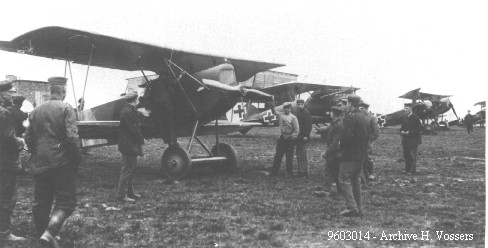
Things started to change in the summer. For unkown reasons, D.VII’s started to burn, and crashed, sometimes killing the pilot. Later it appeared that the extreme high summer temperature of 1918, with insufficient cooling, made incendiary ammunition go off spontaneously. This was also caused by the poor quality of incendiary ammunition. By making extra cooling openings, and replacement of the ammunition, these problems were over.
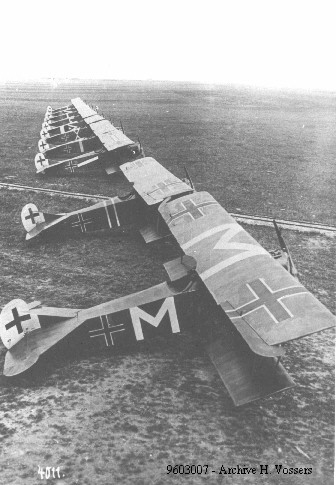
Numbers at the front
This is a list of the number of Fokker D.VII's at the front.
MONTH | NUMBER AT THE FRONT |
| April 1918 | 19 |
| June 1918 | 407 |
| August 1918 | 838 |
| November 1918 | 775 |
Total number of D.VII’s ordered exceeded 3000, but not all were built.
When the war ended, Germany was ordered in the Armistice demands to hand over a number of airplanes, 'fighters and bombers, first D 7's and night bombing machines'. Not all were collected, some were deliberately destroyed, others were hidden in sheds. But still, a great number were collected by the Allies to be tested and sometimes used in their air forces. A number of Fokker D.VII's appeared on the German civil register and were operated by civilian or governmental agencies.
After the war
When the war ended, Germany was ordered in the Armistice demands to hand over a number of airplanes, 'fighters and bombers, first D 7's and night bombing machines'. Not all were collected, some were deliberately destroyed, others were hidden in sheds. But still, a great number were collected by the Allies to be tested and sometimes used in their air forces. A number of Fokker D.VII's appeared on the German civil register and were operated by civilian or governmental agencies.
A two-seat variant of the Fokker D.VII was built after the war by the Hüffer Flugzeugbau as the H.S.D. II and D-VIII.
This is a (not complete) list of known civil registered Fokker D.VII's on the German civil register.
REGISTRATION | WERKE NR | MILITARY SERIAL | OPERATOR | NOTES |
| D-88 | Badische LV GmbH | Destroyed in September 2021 by the IAACC | ||
| D-139 | Lloyd Ostflug | |||
| D-179 | 7609/18(?) | D.L.R. | ||
| D-299 | Rumpler | |||
| D-367 | 6531/18 | Paderborn Police Air Support Unit | ||
| D-368 | 7667/18 | Paderborn Police Air Support Unit | ||
| D-369 | 10087/18 | Paderborn Police Air Support Unit |
The Fokker D.VII in the Nazi era
In 1936, a Fokker D.VII appeared on the German civil register: The D-EIRA, with a swastika on the rudder. This was the former 'CH-46'/'631' that flew in Switzerland and was given to Germany for museum purposes. It was flown from Dübendorff to Germany by former World War 1 pilot Ernst Udet.